Daily Creative Arabia in Conversation with Heba Ismail, a Jeddah based cubist painter.
Article & Graphics by Rania Abdalla
Paintings by Heba Ismail
Paintings by Heba Ismail
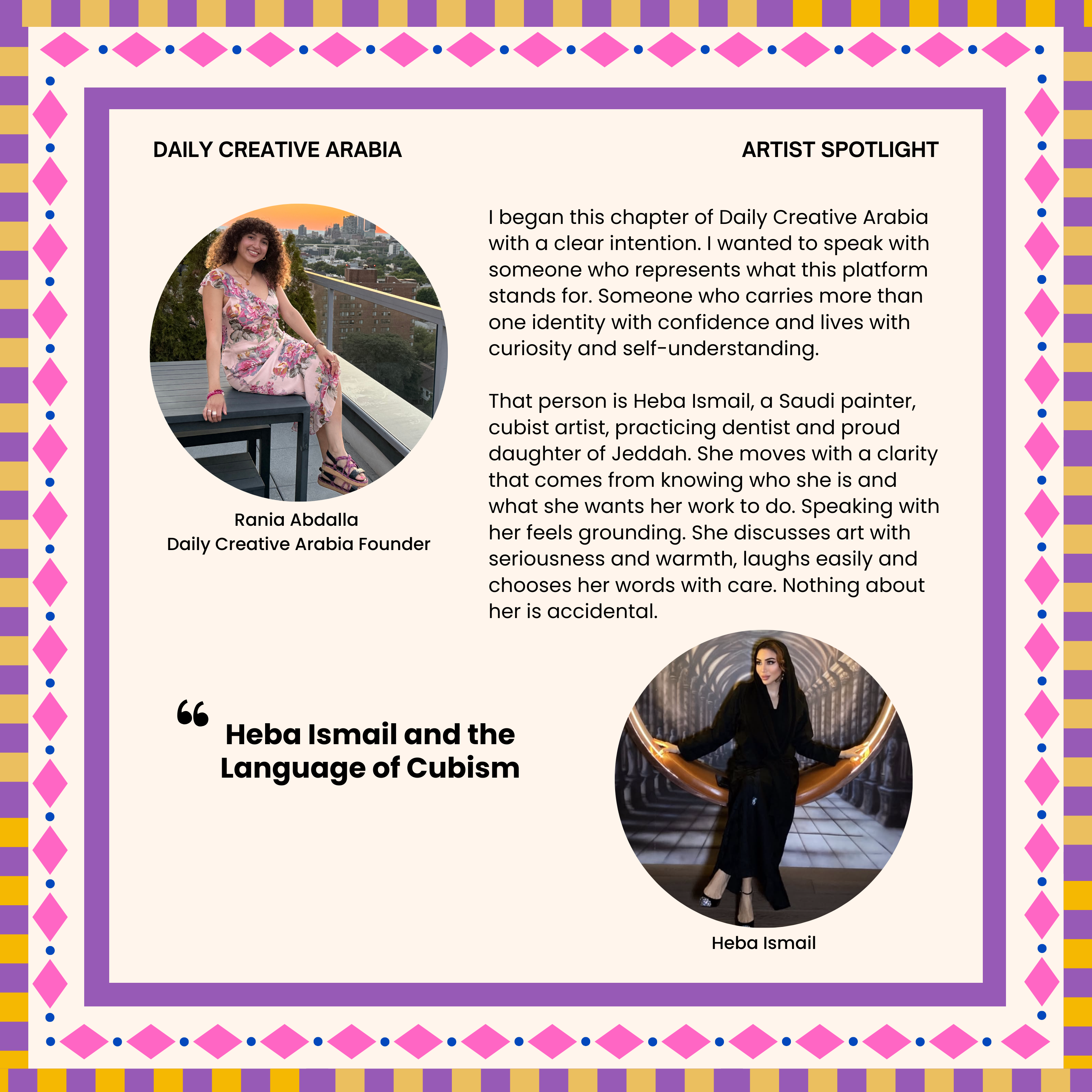
I returned to Daily Creative Arabia with a simple intention. I wanted to begin this new chapter by speaking with someone who embodies what this platform stands for. Someone who carries more than one identity with confidence. Someone who is building a life through curiosity, resilience and self-understanding.
That person is Heba Ismail, a Saudi painter, cubist artist, practicing dentist and a proud daughter of Jeddah. She moves through the world with a sense of clarity that comes from knowing who she is and what she wants her work to do. Speaking with her feels grounding. She talks about art with a mix of seriousness and warmth. She laughs easily, pauses thoughtfully and chooses her words with care. Nothing about her is accidental.
The Beginning of an Artist
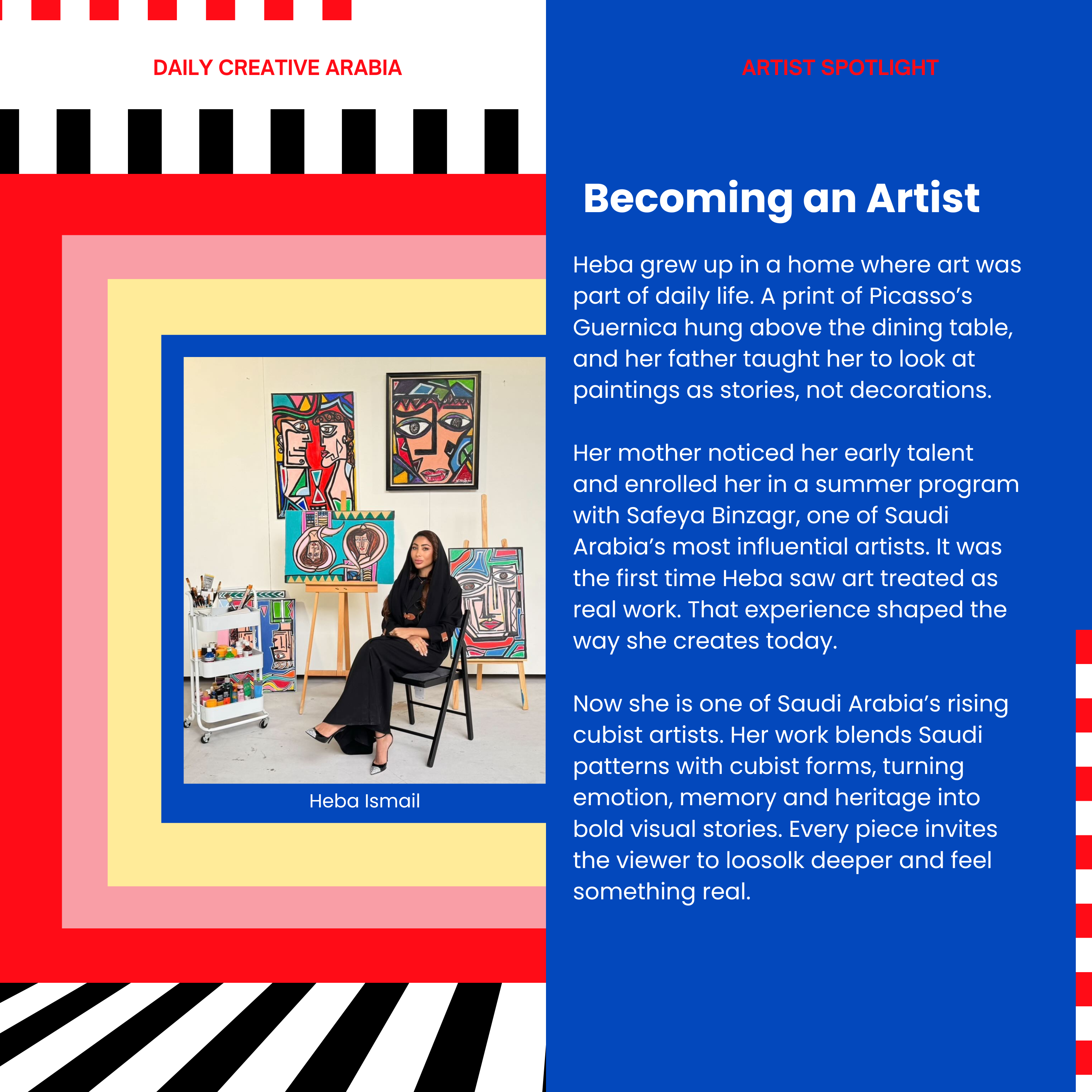
Heba was born in a very artistic and art-oriented home in Jeddah. Both of her parents majored in history, so conversations about culture and significant figures were normal. In their dining room hung a print of Picasso’s Guernica. Her father often paused in front of it and explained the painting to her. He introduced her to Picasso, to different art movements and to the idea that paintings are built on intention, not decoration.
Before the internet made research simple, he created what she calls “encyclopedia classes” at home. He would quiz her and her siblings on artists, periods and styles. It was his way of teaching them that art has structure and that understanding it requires attention and context.
Heba remembers a conversation with her father when he talked about how art changed once cameras were invented. Before photography, the “best” artist was the one who could copy reality most accurately. Once cameras arrived, that job was over.
“So my father told me, if a camera can show us what exists, then art has to show us what does not exist,” she says. “Show me what is in your mind. Show me how you see.”
Her mother supported her in a different but equally important way. Heba was always drawing on notebooks, textbooks and any corner she could find. Her mother noticed and encouraged it. She enrolled her in a summer program with Safeya Binzagr, one of the earliest Saudi women to build a formal art practice. For Heba, seeing a Saudi woman treat art as serious work was a turning point. It showed her that art could be a professional path, not just a hobby.
These early experiences shaped how she thinks about creativity. She believes young artists need support, not early criticism. She often says that many artistic paths are discouraged too soon. Her own childhood taught her that a supportive environment can change everything. It can turn a child drawing in the margins of her books into someone who understands that creativity has value and a place in the world.
Heba also sees art as a way to document moments and emotions that cannot be fully captured in words. Painting allows her to record a feeling, a memory or a presence that might otherwise disappear. She says art is not something you analyze first. It is something you feel, and that is what drew her to painting from the beginning. “Art lets me document a feeling before it disappears. It is not something you analyze. It is something you feel,” Heba says.
Navigating Two Identities
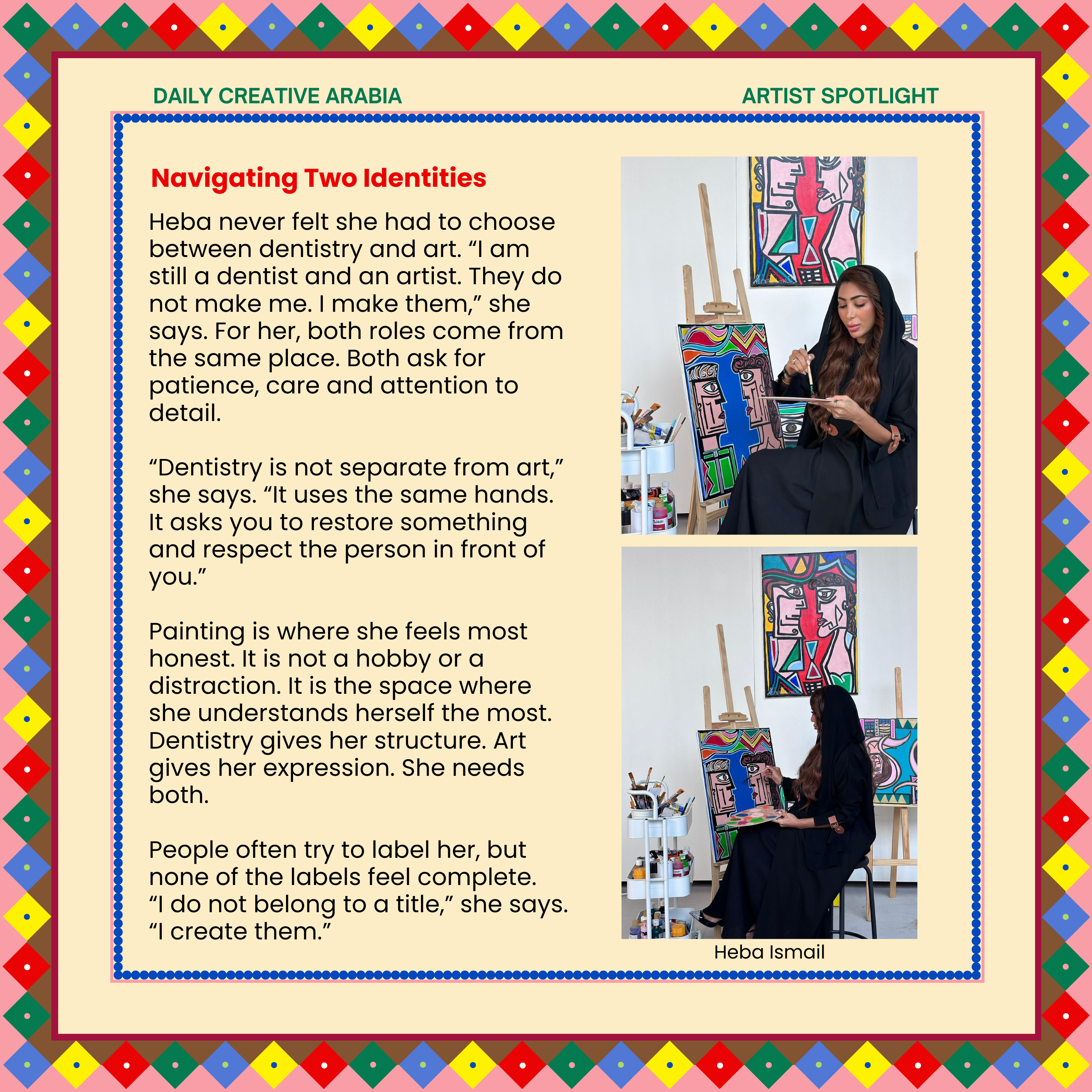
When Heba enrolled in dental school, people assumed she had chosen a path. They asked which one she would pursue. Would she become a dentist or an artist. She never accepted the idea that she had to choose.
To her, dentistry and art sit closer together than people imagine. Both require calmness, observation and attention to detail. Both rely on steady hands and the ability to focus for long stretches with intention. Both involve restoring what is broken and sensing what a person might feel but not say.
“Dentistry is not separate from art,” she says. “It uses the same hands. It asks you to restore something and respect the person in front of you.”
She sees no contradiction in living inside two worlds. Dentistry taught her discipline and patience. Art taught her expression and trust in instinct. Together they keep her grounded. They remind her that a person can hold more than one identity without silencing the others.
People often try to label her. Artist. Dentist. Creator. None of the words feel complete on their own.
“I do not belong to a title,” she says. “I create them.”
Heba moves between two practices that look different but rest on the same foundation: care, attention and the belief that what you shape with your hands can change how someone feels. For her, both paths are equal. One does not replace the other. They grow together.
Cubism, Crime Stories and the Love of Symbolism
Heba speaks about cubism with an ease and affection that comes from growing up around it.
She compares her paintings to crime documentaries and riddles. She loves symbolism. She loves leaving clues.
“I do not want to show you everything directly,” she says. “I want you to walk through the painting and find your own ending. Like a maze with many exits. You can take several paths and reach different stories from the same piece.”
This is why many of her works contain layered shapes, fractured profiles and repeating eyes. They are not there to confuse. They are there to stretch the story so more than one truth can live inside it.
How Heba Uses Emotion and Symbolism
Heba often starts painting before she understands what she feels. The meaning appears after the canvas is finished. Painting helps her see emotions that were not easy to name in the moment.
Her symbols come from that process. Her eyes rarely look in the same direction. Some look inward. Others look outward. She says emotions never move in one straight line, so the eyes should not either.
Hair appears in many forms. Sometimes it is neat. Sometimes it looks heavy or unsettled. In one piece she paints a messy bun in brown, black and gray to show the weight of experience a woman carries.
She also places a chessboard pattern inside the body. Each line represents a period of life or a lesson. When the lines increase, it signals someone who has lived through more and held more.
These symbols create a visual language that helps the viewer understand what the figure is feeling. They set the stage for the pieces that deal with anger, pain and the way people respond to emotional pressure.
Hurt People Hurt People
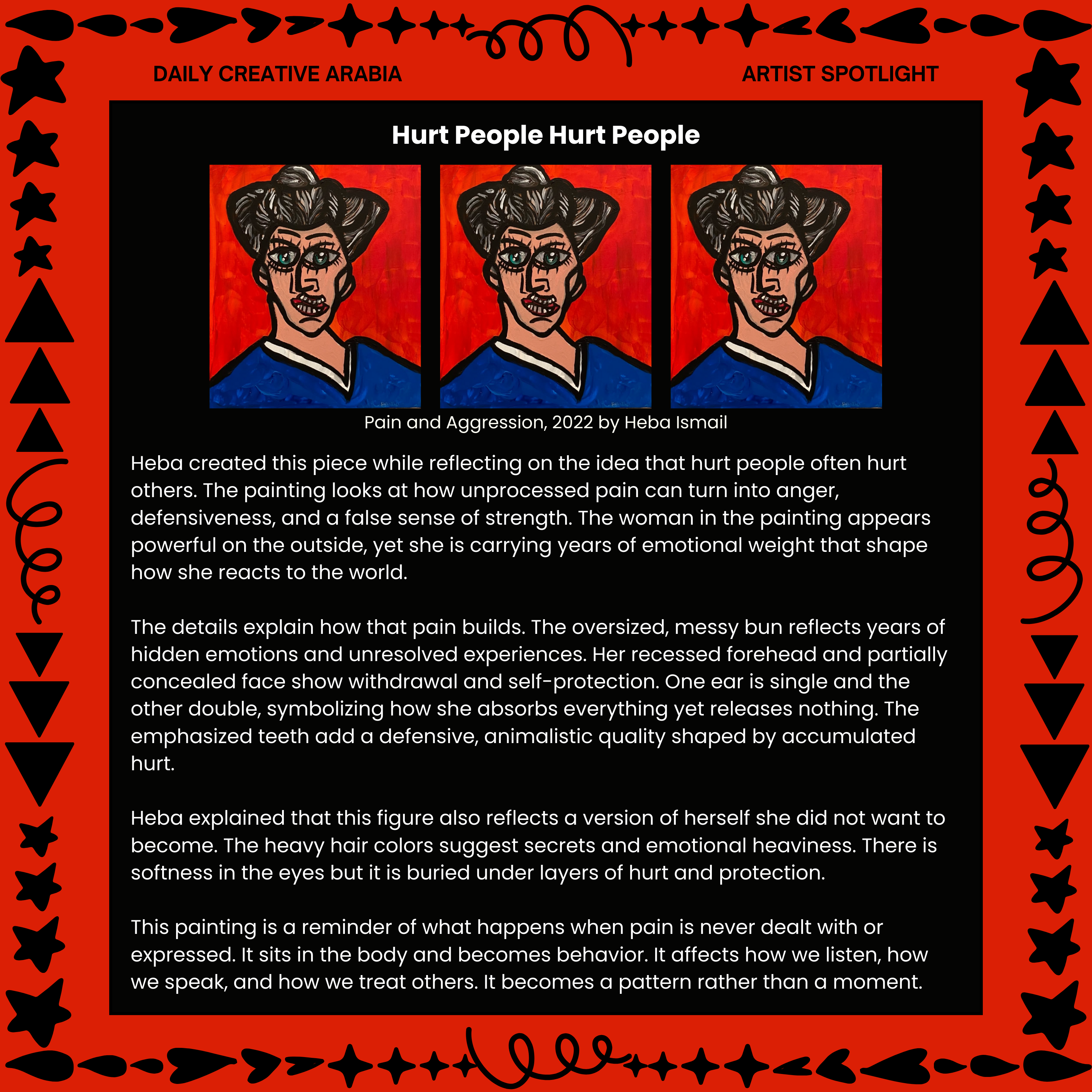
The woman in the painting is sharp and intense. Her teeth are emphasized in an almost animal way. Her hair is large, tied in a messy bun, filled with lines and shadows. One ear appears doubled, as if she has two ears on one side. She has no forehead, which gives the impression that she is withdrawn and unwilling to reveal anything. She does not want to show her face at all. The mouth, with its sharp teeth, is meant as a warning. “I wanted to give her an animalistic feature,” Heba says. She can hurt with words. She can bite.
“She looks powerful, but not in a good way,” Heba explains. “Her hair is big because she holds many secrets and feelings. The messy bun shows she does not care to appear neat anymore. She has one side with two ears, which means she hears everything, the good and the bad. And there is no exit. She keeps it all inside. It never leaves.”
Heba describes her as someone who has turned her pain into armor, whose anger hides deep hurt. Yet she believes there is love in this woman’s eyes, compassion buried under layers of anger and disappointment. She painted this figure as a possible future version of herself, a reminder of who she refuses to become.
“It is like a picture of myself if I stayed in my pain,” she says. “If I kept choosing anger, I would become her. So I painted her with love, as a reminder not to go there.”
Behind the Hidden Mask
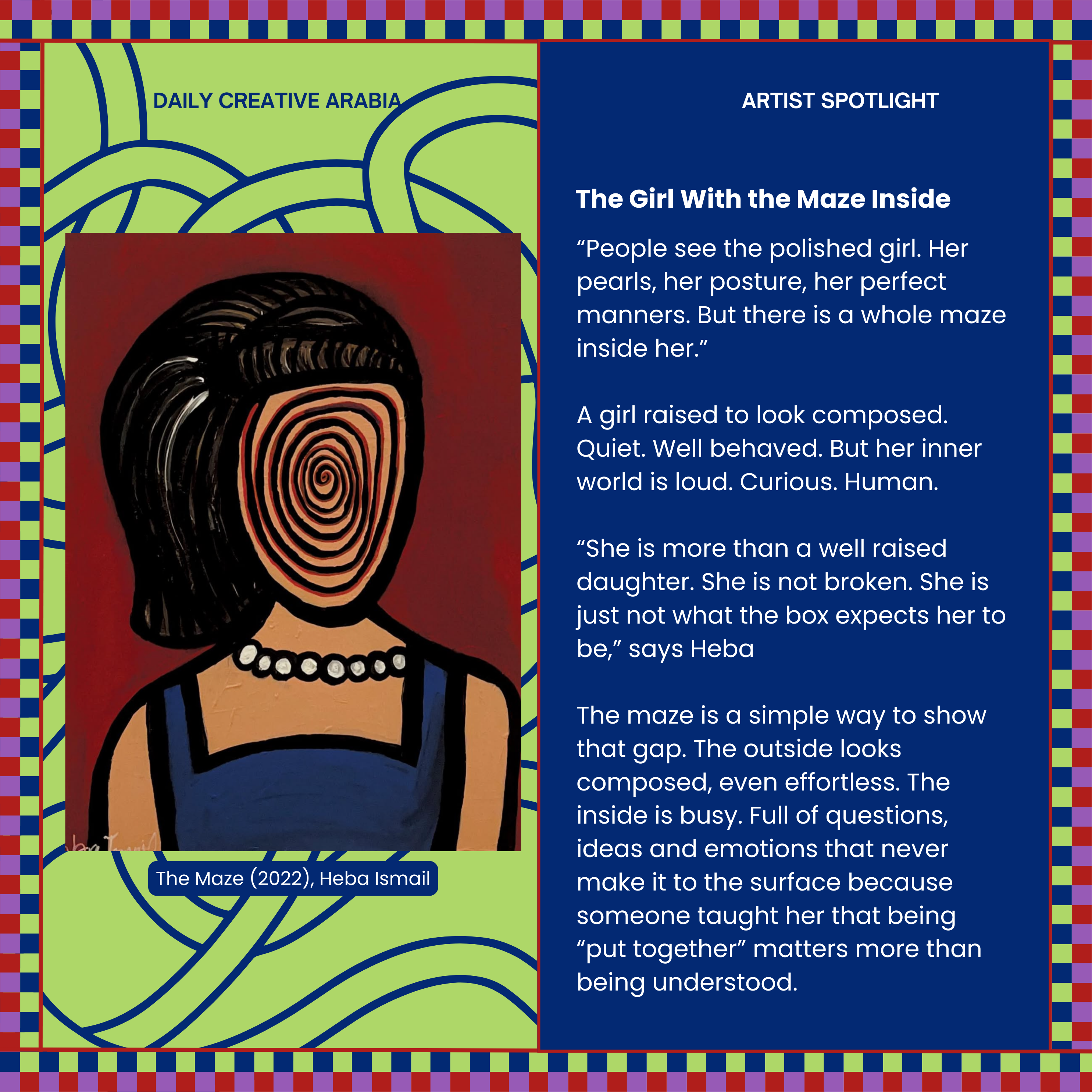
Another beloved piece is what Heba calls The Maze portrait. At first glance, the woman looks like the perfect daughter. Pearls. Neat hair. Modest dress. A composed posture. The kind of girl people point to and say, “She was raised well.”
Inside her chest there is a maze.
“This is me,” Heba says. “And it is many girls I know. From the outside you look so polished. Inside you are full of movement, questions and ideas. People think it is a phase. It is not a phase. It is who you really are.”
The maze represents all the paths she wants to explore but does not always feel allowed to take. It also speaks to the exhaustion of constant presentation.
“It is about a girl who grew up in a family where she has to look her best all the time,” she says. “At some point it was so draining that she did not want to leave my room. If every time she steps outside she have to perform perfection, so it is easier to stay hidden.”
Heba is grateful that younger generations in Saudi Arabia are beginning to loosen these rules. She sees more girls dressing with freedom. Less pressure to appear polished every hour of the day. For her, that shift is not about fashion. It is about mental health.
“It is freeing,” she says. “We need more of that.”
One Woman, Three Versions of Herself
Heba created a series of three paintings: Upended, Bloody Mary and Intertwined. She painted them during a period where she felt pulled in different directions. Each piece shows one woman, but with a different emotional viewpoint.
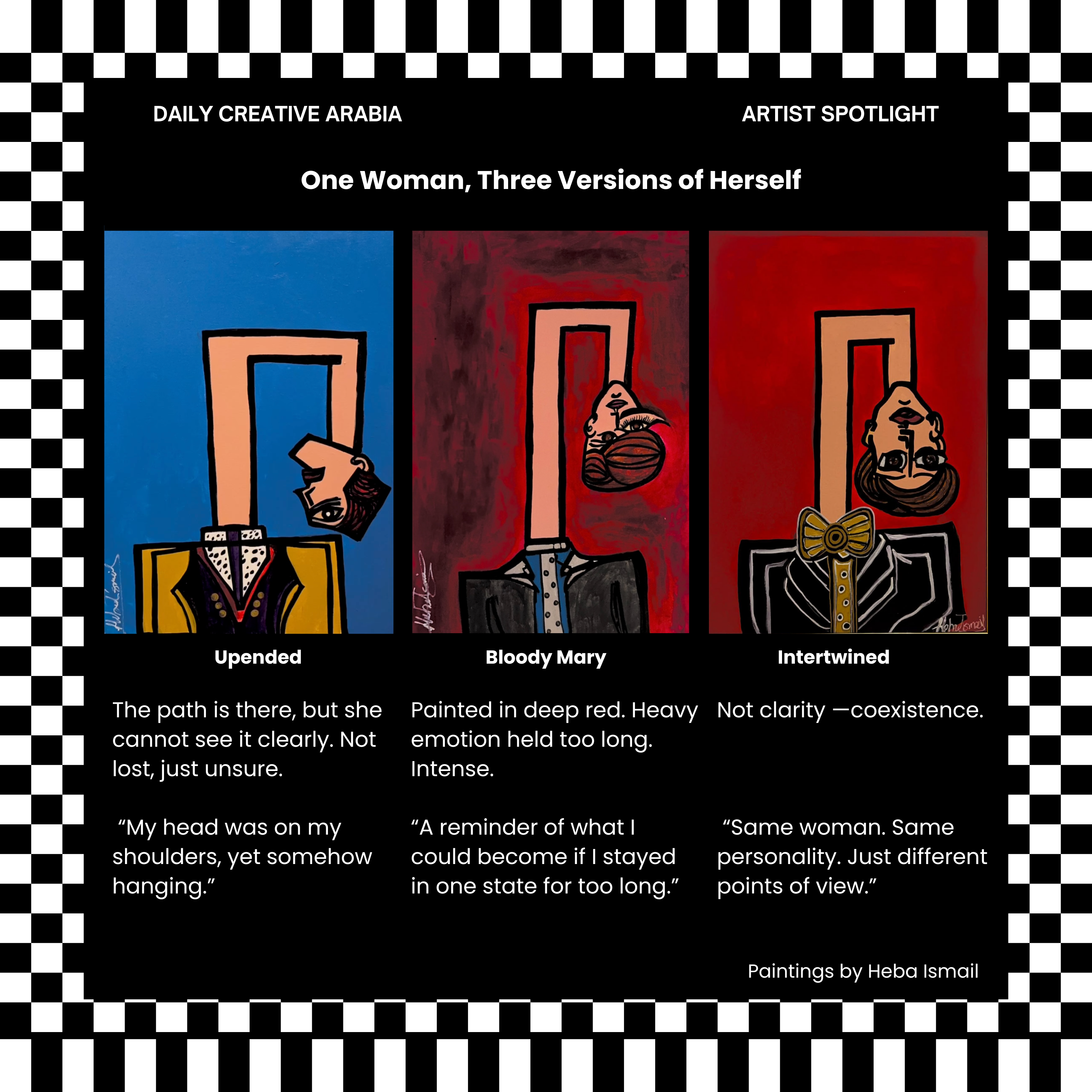
Upended
This painting carries a sense of confusion. The figure stands straight, yet the head feels suspended. She described it as a moment where the path exists, but the clarity does not. The painting can also be flipped upside down, which reflects the idea of seeing the same moment from more than one angle.
Bloody Mary
This is the most intense piece in the series. The deep red around the figure represents heavy emotion. She used this color because it felt like something strong that needed to be expressed. For her, the painting shows what happens when a feeling sits for too long without being understood.
Intertwined
This painting brings the story together. Three heads tilt in different directions, yet belong to the same woman. Heba was exploring how one person can hold many viewpoints at the same time. She explained it simply: they are the same woman with the same personality, but each head reflects a different side of her.
Painting the series helped her understand her thoughts more clearly. Putting the emotion on the canvas made it feel lighter and easier to read. Once the story was in front of her, it had less power over her. She compares it to journaling, where writing something down helps the mind see it with more clarity.
Loving and Understanding Gray
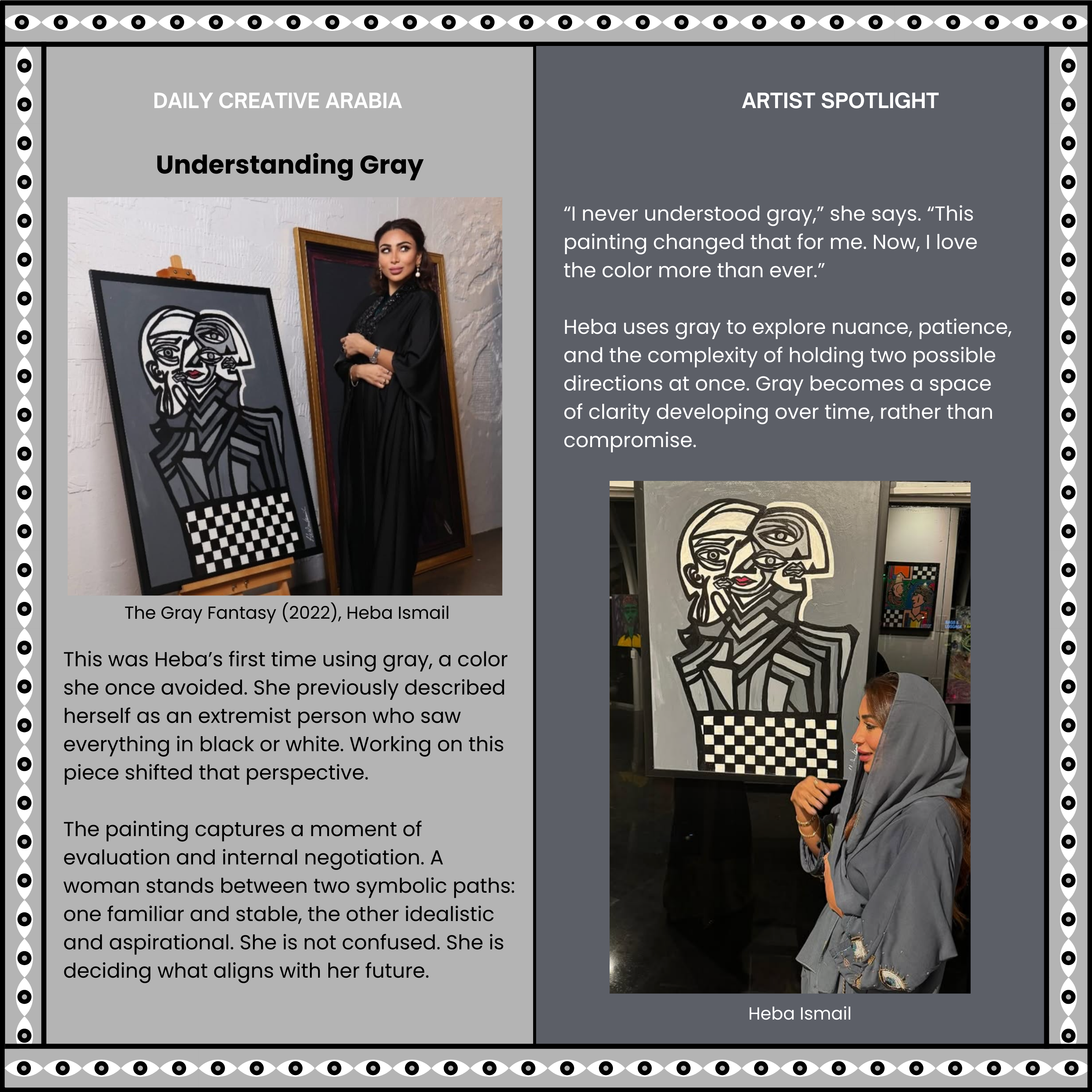
For a long time, Heba hated the color gray. She saw the world as black or white. Right or wrong. Yes or no. Gray felt like indecisive.
Then life taught her how much of our reality lives in between.
She painted a black and white piece, The Gray Fantasy, with many shades of gray. In it, a woman stands between two figures. One represents the man she settled for. The other represents the idea of a partner who truly fits her and wishes for. She is positioned in the center, caught between safety and desire, between what is available and what she dreams of.
It looks like a love triangle. She says it is actually about something deeper.
“In life we are often told that in between is wrong,” she says. “We push everything to be either true or false. But there is so much in between. So many parts of us that cannot belong to one side.”
This painting was the first time she allowed gray into her palette. Now she wears it. Paints it. Respects it.
“Gray is honesty,” she says. “It is admitting that you are still learning, still deciding, still changing. That is not weakness. It is real life.”
Ascending and Leaving What No Longer Fits
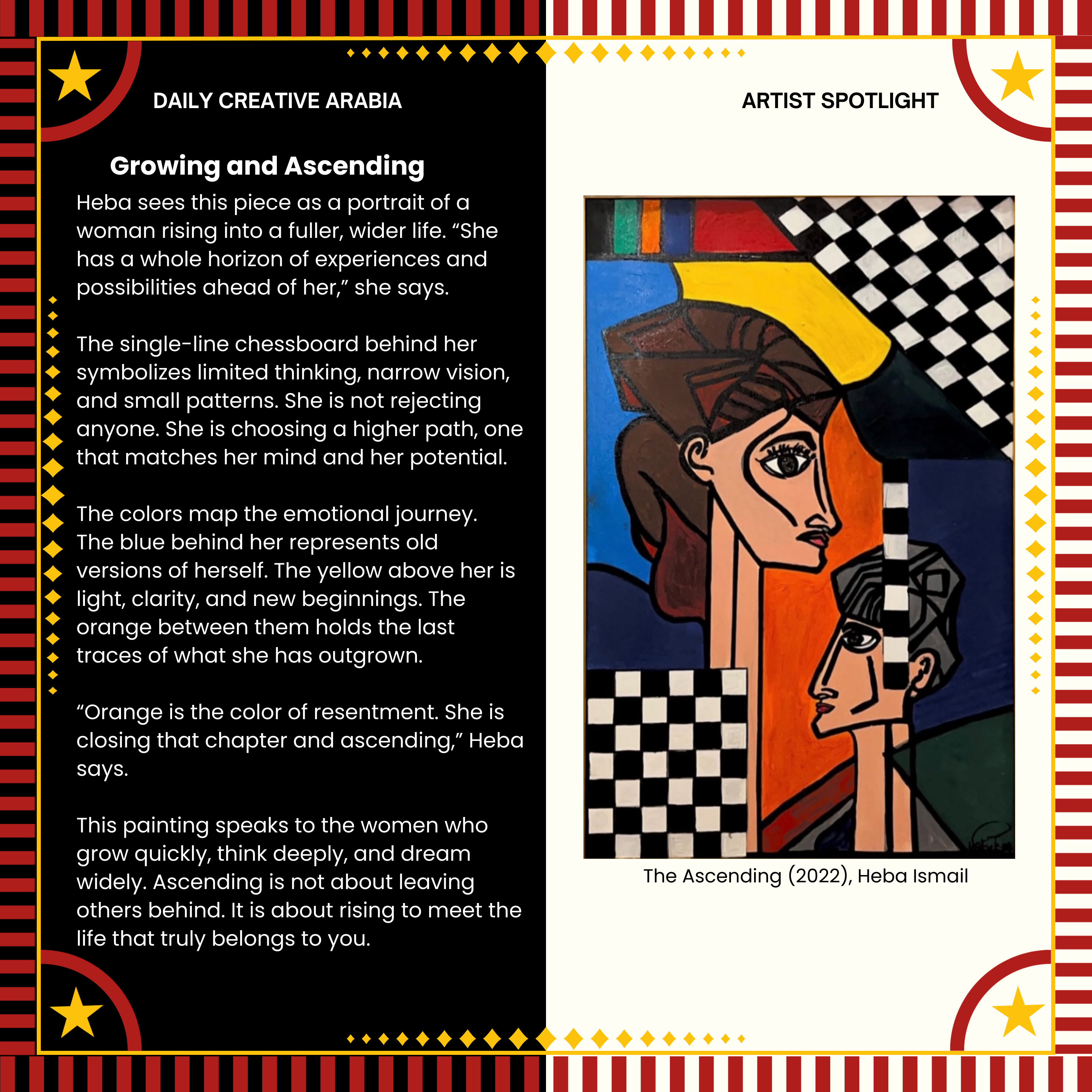
In another work, The Ascending, a woman appears to rise above a shared past. The man behind her has a single line of “chessboard” across his head. She has several. Each line represents a phase of life, an experience, a lesson.
“Life is a game of chess,” Heba says. “In this piece the woman is ascending above a relationship where there was no intellectual match. She is moving toward a wider horizon.”
Yellow floats above her as a symbol of light and possibility. Blue stays behind as the life she is leaving. Between them there is orange, a color she associates with resentment and old pain that is finally closing.
“It is about women who decide to ascend,” she says. “To leave behind what was never right for them and move toward something that matches who they are.”
When I asked what she would tell younger women who feel unsure about whether to stay, leave or settle, her answer was simple and kind.
“If he goes against your values, the answer is no,” she says. “If you would not want your daughter with someone like him, the answer is no. You do not need perfection. You need safety. You need someone who lets you be yourself and does not try to change your core.”
Talking to Her Younger Self
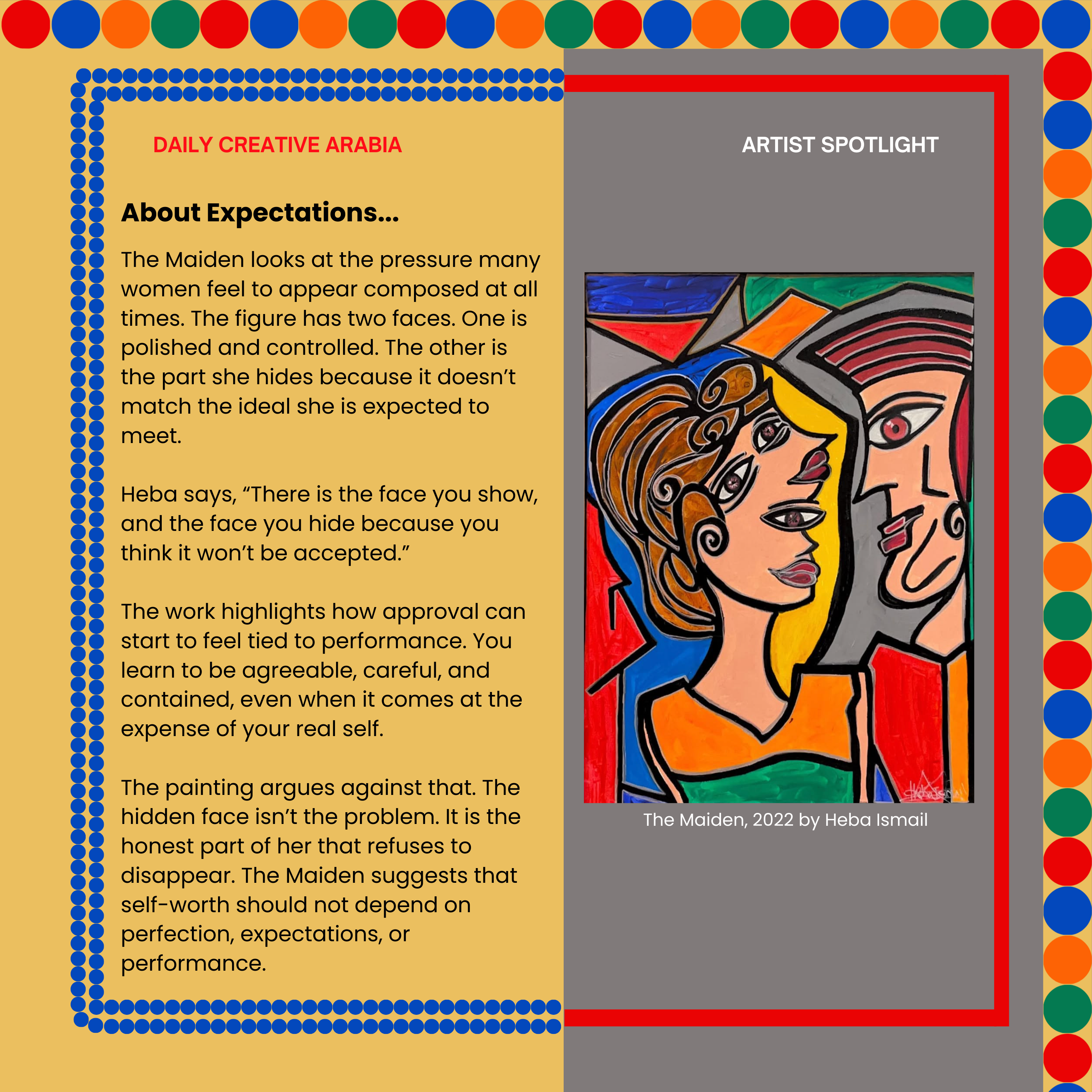
When I ask Heba what she would tell an eight year old girl, she does not pause.
“I would tell her she is beautiful every day,” she says. “Just the way she is. She does not need her hair a certain way or makeup or a specific dress to deserve love or kindness.”
Much of her art carries that message, especially The Maiden. The figure stands between innocence and adulthood, holding both vulnerability and strength. It reflects what many women inherit from society and culture, which is the belief that worth must be proven through perfection, performance or constant giving.
For The Maiden, Heba speaks about how many people grow up understanding love through effort. They learn that love is conditional, tied to giving, helping and overdelivering. She explains that when someone gives endlessly, especially without balance, the meaning of love becomes distorted. This idea informs the way she approached the piece and the message behind it.
“If you are always the giver, even to the wrong person, you can turn them into a narcissist,” she says. “You give them all the power.”
She hopes younger generations learn a different message.
“You are worthy of love regardless,” she says. “You can be whoever you want to be and you will still be loved.”
Her paintings echo that truth. Soft figures who are also unsure. Strong figures who are still learning. Women who no longer believe they must perform to receive affection. Women reclaiming the quiet confidence that unconditional love begins with the self.
A Saudi Story in the Language of Cubism
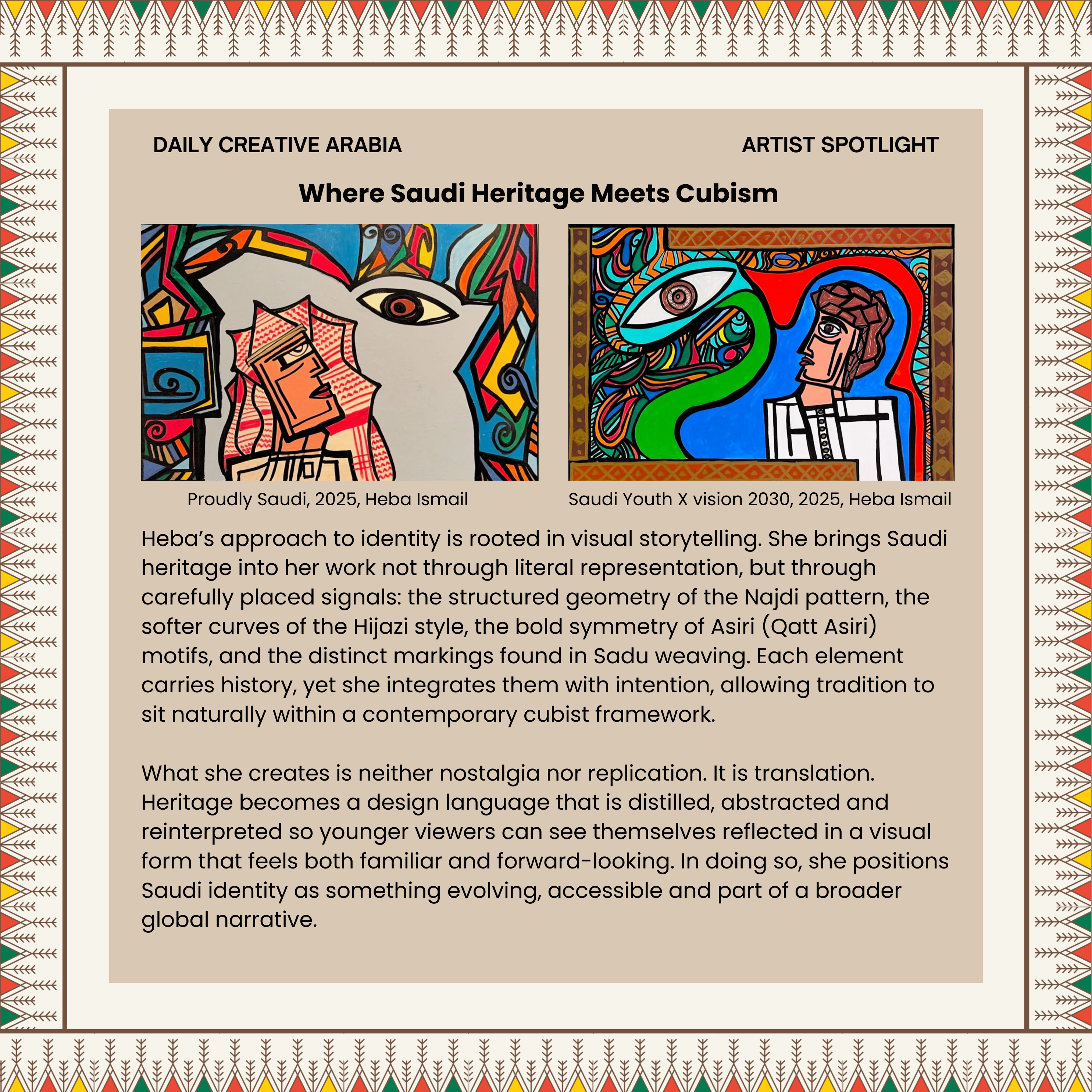
Heba is deeply proud of being Saudi. She is originally from Makkah, and she speaks about Saudi heritage with the same affection she holds for cubism. She knows cubism is not an Arab invention, and that contrast interests her. She likes working in a global artistic language while adding something unmistakably Saudi to it.
“In Saudi Arabia there is so much art in our heritage,” she says. “It is beautiful and very diverse. Each region has its own language.”
Those regional languages appear quietly throughout her paintings. Sometimes it is Qatt Al Asiri from the south, with its bright geometric forms created by women. Other times it is Sadu, the linear motifs woven into northern tents and textiles. She also draws from Najdi designs in the central region, Hijazi motifs from the west, and the softer ornaments inspired by the eastern coast. These elements show up on clothing, around borders, or within the background of her portraits — not loudly, but with intention.
“Even though I am from the western region, I celebrate all the regions,” she says. “I try to put them in my work, even if it is minimal. It deserves to be seen.”
For Heba, the magic lies in the meeting point between heritage and cubism. Cubism comes from a different world, yet she enjoys bringing Saudi patterns into its structure and rhythm, placing something familiar inside a form that once belonged entirely to Europe.
“I want to put my Arabic touch into cubism,” she says. “And maybe one day it will be part of art history. Hopefully future generations will learn about our history through our art.”
Modern Saudi Femininity
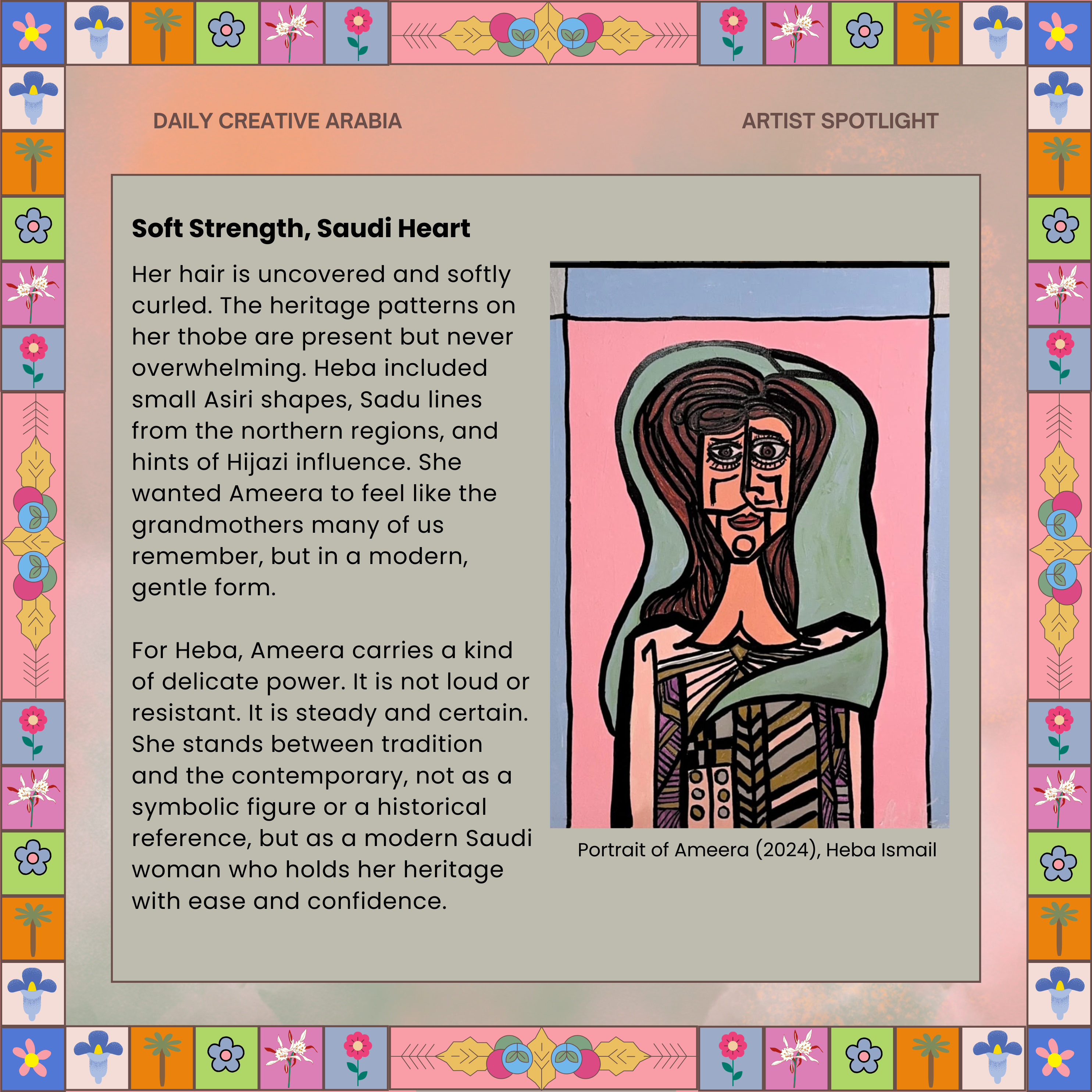
In one painting often referred to as “94” she dresses a woman in a modern thobe that carries motifs from Qatt Al Asiri in its colorful triangles and lines. The center carries a band inspired by Sadu from the north. She wanted to show a feminine figure who feels delicate and powerful at the same time. A modern Saudi woman who carries the whole kingdom on her clothes.
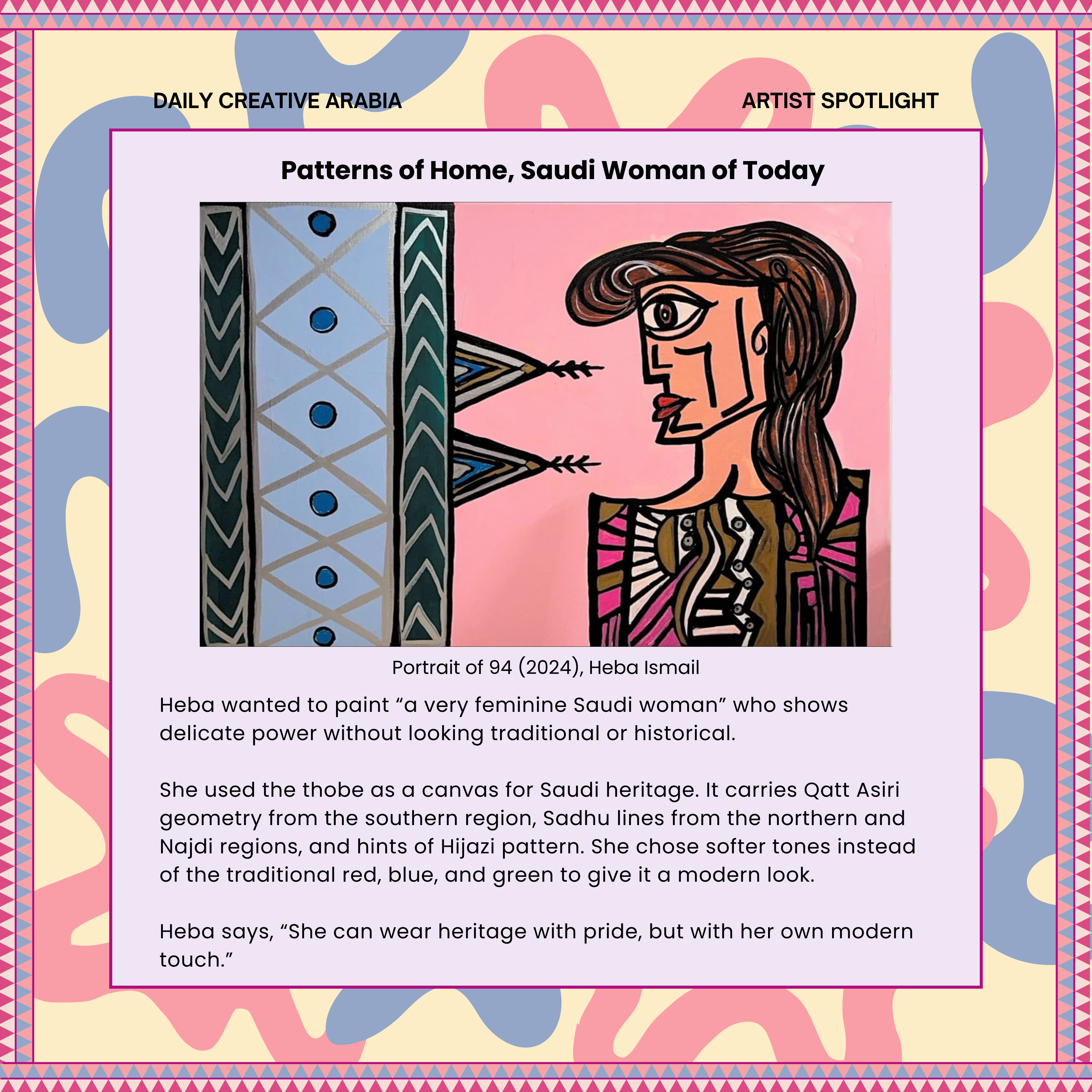
In another work, “Ameera,” she paints a woman who looks like a grandmother but dresses in a contemporary way. Her hair is visible. The colors are pastel and soft.
“I wanted her to feel very feminine, light and strong at once,” Heba says. “It is our culture and history in a modern body.”
Heba’s work is already reshaping how Saudi stories appear on the canvas. I am excited to see where her vision goes next, and how she will continue weaving Saudi heritage, modern femininity and cubism into her own unmistakable language.
Don't miss out on the latest from Heba Ismail - make sure to follow her on IG @HebaIsmail.art.